
Welcome To IIP Learning Hub
IIP Learning Hub is an authoritative reference designed to help both new and existing advisers:
Understand our professional expectations around ethics, record‑keeping, client engagement and continuous improvement
Navigate daily compliance obligations under the IIP licence and the broader AFSL framework.
Leverage our technology stack to drive efficiency and quality.
Access templates, processes and support quickly, so you can focus more time on serving clients.
Meet your instructors
✳
Meet your instructors ✳

SARA
IIP’s AI Compliance Assistant

FINLEY
IIP’s Brand Ambassador
-
Chapter 1 - An Intro to IIP
-
Lesson 1: Welcome to Insight Investment Partners
Introducing Insight Investment Partners, Our Mission, Values, Compliance Culture and Key Contacts.
-
Lesson 2: Your Authorised Rep Responsibilities
An overview of the professional and ethical framework we operate in and details the practical application of that frameworks.
-
Lesson 3: The Onboarding Process
We are excited to have you onboard.
Let’s take a look at the background checks and steps for joining IIP as an Authorised Rep.
-
Lesson 4: Accessing Your FSG
Now you are Authorised, let’s look at how you can access your FSG to provide to your clients.
-
Lesson 5: Transitioning Your Clients To IIP
This article explains the client transition framework used at IIP and outlines the key steps advisers must follow when onboarding clients after joining the licensee.
-
Lesson 6: Accessing Support
Feeling a bit lost and need some help? Let’s go through what actions you can take to ensure you can get the support you need from our subject matter experts.
-
Lesson 7: Creating A Paraplanning Request
Do you have an SOA for our paraplanning service?
Follow this guide to assign the SOA for paraplanning
-
-
Chapter 2 - Finley, Sara and Rima
-
Lesson 1: Finley, Sara and Rima
Together, Finley, SARA and RIMA support three essential parts of running a modern financial advice practice:
-
Lesson 2: Transitioning to Finley, Sara and Rima
Maintaining 2 CRM’s is a headache.
So we have integrated iComply2 with Xplan, so you can maintain your client records in one CRM.
Connecting to Xplan is simple.
-
-
Chapter 3 - SARA, your AI Compliance Agent
-
Lesson 1: An Introduction to SARA
Introducing SARA, your AI powered compliance assistant.
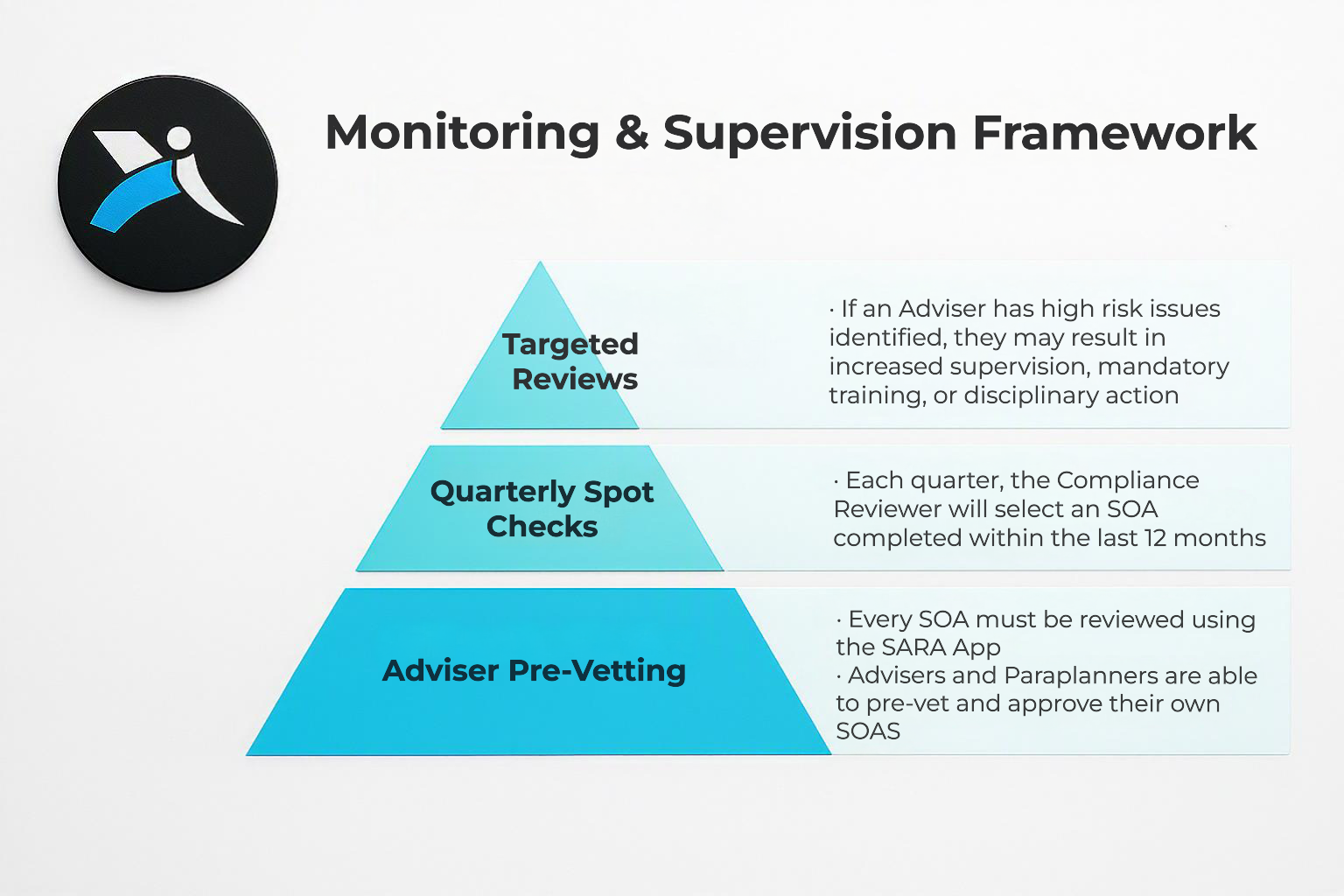
Sara is an integral part of our advice monitoring and supervision framework.
-
Lesson 2: Adviser Pre-vetting Guide
Pre-Vetting with the new Sara
We have re-built Sara, the Statement of Advice Review Assistant.
You can create your SOA Vetting Request and send the SOA to Sara from within the new Sara App.
-
Lesson 3: Running a Re-check on your SOA
Has Sara marked any compliance checks as Review or Fail?
Using the re-check functionality, you can re-upload your updated documentation to Sara for a re-check.
Sara will review the updated documentation against any flagged checks.
-
Lesson 4 - Accessing Advice Policies
You can access all our AFSL Advice Policies from the Advice Policy Register in Sara
-
Lesson 5- Access Document Templates
Templates, templates, templates.
All the advice templates you need to provide compliant advice to your clients.
-
Lesson 6 - Reporting an Incident or Breach
Sometimes, things go wrong.
When running a financial advice business, it is expected that breaches and incidents will occur.
Nobody is perfect and breaches and incidents will happen.
-
Lesson 7 - Client Complaints
All complaints must be handled in accordance with the Licensee processes.
Before resolving any complaints, report the complaint and refer to the complaints handling process.
-
Lesson 8 - APL Requests
Do you want a product added to the APL?
Using the iC2 Compliance Hub, you can request one off, or general approval for new product.
-
Lesson 9 - Non-Cash Benefits
Have you received a non-cash benefit?
In this guide, we will go through the steps involved to log a non-cash benefit with IIP.
-
Lesson 10 - Sophisticated Investor Certificates
Store Sophisticated Investors Certificates in the SPI Register.
In this guide, we will go through the steps involved to add a Sophisticated Investor Certificate to the register
-
-
Chapter 4 - RIMA, your Revenue Management Agent
-
Lesson 1 - Fee Collection
Understand our fee collection process.
What fee types can i charge, and how can i collect the fees from my clients.
-
Lesson 2 - Raising an Invoice
Licensee Invoice systems can be clunky..
The challenge has been that there are too many moving parts
The invoicing and accounting is done in Xero, the client CRM is Xplan (or similar), the revenue management is done by Revex….
But all these systems don’t talk…..
-
Lesson 3 - Setting Up Direct Debits
Set Up Direct Debits For Your Fee Agreements
Let’s take a step by step look at how to create direct debits in iC2 Revenue using the Ezidebit payment solution
-
Lesson 4 - Adviser Pay Runs
Let’s Get To The Good Stuff.. How Do You Get Paid?
We have created a dedicated portal for managing adviser pay runs.
-
Lesson 5 - Processing Client Fee Rebates
Need to process a rebate to a client?
Complete the Client Rebate Authority and send through to support
-
-
Chapter 5 - The Advice Process and Documentation
-
Lesson 1: Navigating the Advice Process
The provision of personal financial advice in Australia is governed by a robust regulatory framework.
Here’s an overview of the Key Steps in the Advice Process.
-
Lesson 2: Engagement Letter
Providing financial advice begins with clarity—and that starts with an engagement letter.
Here’s why this simple document plays a crucial role in every client–adviser relationship. -
Lesson 3: Understand the Review Process
Understand what constitutes a client review and the documentation requirements
-
Lesson 4: Secure Document Storage
Effective client file management is essential to demonstrating professionalism, regulatory adherence, and a commitment to acting in clients’ best interests
-
Lesson 5: Further Advice/ROA: Frequently Asked Questions (FAQ)
Gain clarity on when an ROA can be used for further advice through commonly asked questions covering key requirements, limitations, and compliance considerations. This lesson helps you understand when a full SOA is required and how to apply the guidance in practice.
-
-
Chapter 6 - The Monitoring and Supervision Framework
-
Lesson 1: The IIP Monitoring and Supervision Framework
Our aim is to establish a robust framework for the provision of financial advice.
This ensures consistent delivery of high-quality financial advice.
-
Lesson 2: Preparing For Your FiIe Audit
Adequately preparing for your audit will ensure a smooth review experience.
Here’s an overview of the File Audit Process
-
Lesson 4: Reviewing the Draft Findings
Your compliance manager has made a draft report of the initial findings
You can review the findings in raise any disputes or concerns before the report is finalised
-
Lesson 5: Remediating The File
Your file review has been finalised
Let’s take a look at how you can action any observations made by the file reviewer
-
-
Chapter 7 - Providing SMSF Advice
-
Lesson 1: Understanding SMSF Advice
SMSFs can provide flexibility and control, but they also carry higher risk and responsibility. This lesson highlights the key considerations advisers must assess before recommending an SMSF, focusing on suitability, risk, and regulatory expectations.
-
Lesson 2: SMSFs Property and Referral Networks
SMSF strategies involving property and referral networks carry heightened regulatory and client risk. This lesson outlines ASIC’s concerns and explains why advisers retain full responsibility for property‑driven SMSF recommendations.
-
Lesson 3: New Ban on SMSF Borrowing for Residential Property
A significant change has now taken effect for Self-Managed Superannuation Funds (SMSFs) using Limited Recourse Borrowing Arrangements (LRBAs).
From 10 August 2026, SMSFs are generally prohibited from entering into a new LRBA to acquire residential real property.
-
-
Chapter 8 - Entering Fee Agreements
-
Lesson 1 - Ongoing Fee Agreements
This lesson sets out the Licensee’s standard for entering into and maintaining Ongoing Fee Arrangements (OFA).
Test your knowledge of OFA’s
-
Lesson 2: The OFA Renewal Process
Consent To Renewal
Renewal can be done within the period starting 60 days before the Reference Date and ending 150 days after the Reference Date.
-
Lesson 3 - Understanding the ‘Reference Date’ in Ongoing Fee Arrangements
This lesson sets out the Licensee’s standard for correctly setting and managing the Reference Date within Ongoing Fee Arrangements (OFAs).
-
Lesson 4 - Fixed Term Fee Agreements
This lesson sets out the Licensee’s standard for entering into and maintaining Fixed Term Fee Arrangements (FTA)
-
-
Chapter 9 - AML/CTF Reforms
-
Lesson 1 - About the reforms
From 31 March, 2026, the government is making changes to simplify and modernise the AML/CTF regime.
These changes to Australia’s anti-money laundering and counter-terrorism funding (AML/CTF) regime help us build a stronger, more proactive intelligence picture.
-
Lesson 2 - Understanding Customer Risk Ratings
Simply collecting a copy of a clients ID is only part of your process.
Your initial and ongoing customer due diligence (CDD) obligations start with understanding the money laundering, terrorism financing risks (ML/TF risks) of your customer.
Let’s look at the risk ratings
-
Lesson 3 - Completing Customer Due Diligence
You have identified your client as low-risk. You must now establish and verify the identity of your customer.
You are expected to collect enough information to verify and distinguish the individual customer from another individual with the same or similar name and other details.
-
Lesson 4 - Enhanced Customer Due Diligence
Enhanced CDD plays an important role in detecting, disrupting and preventing ML/TF. Conducting enhanced CDD helps you identify, assess, manage and mitigate a customer’s ML/TF risks.
Enhanced CDD must be applied in specific circumstances.
-
Lesson 5 - Maintaining Accurate Records
Make and keep records that show compliance with AML/CTF obligations.
We have released the new Risk Assessment Form in the Compliance Hub. If you use either Xplan or iComply2, you can record your risk assessment directly in the CRM
-
Lesson 6 - Identifying & Reporting Suspicious Activity
We have created suspicious activity indicators to help you identify potential money laundering, terrorism financing and other serious criminal activities. These indicators can inform your transaction monitoring alerts that trigger further review.
-
Lesson 7 - AML/CTF Reforms: Frequently Asked Questions (FAQ)
Gain clarity on key AML/CTF reforms through commonly asked questions covering regulatory changes, compliance impacts, and practical next steps. This lesson helps you understand what’s changing, why it matters, and how to apply the reforms in your role.
-
-
Chapter 10 - DBFO Tranche 1
-
Lesson 1 - Website Disclosure Information
Website Disclosure Information gives advisers the flexibility to decide how they disclose information to clients that is otherwise required to be in an FSG
-
Lesson 2 - OFA & Consent
As part of the Delivering Better Financial Outcomes (DBFO) Package, the Albanese government has made amendments to the obligations relating to ongoing fee arrangements and consents.
-
Lesson 3 - Informed Insurance Consent
From the 9th July 2025, advisers that receive commissions as part of the issue or sale of life insurance to a retail client in personal advice situations must obtain informed consent.
-
-
Chapter 11 - Cyber Security and Use of Artificial Intelligence
-
Lesson 1 - The Importance of Cyber Security
Cyber security isn’t just an IT problem — it’s a core business risk for every financial-advice practice.
As custodians of sensitive client data and regulated financial transactions, advisers must understand how even a small lapse can create large-scale harm.
-
Lesson 2 - Common Cyber Threats Facing Advisers
What are you up against every day?
The key attack vectors criminals use to steal money or data from advice businesses
-
Lesson 3: Practical Ways To Protect Yourself
Learn the basics.
It’s easy to improve your cybersecurity! Take these simple steps today to protect yourself.
-
Lesson 4 - Responding to a Suspected Cyber Incident
Golden Rule: Speed, structure, and transparency.
The longer an incident goes uncontained, the higher the financial, legal and reputational cost. -
Lesson 5 - AI Tool Privacy: Chat Controls and Opt-Out Obligations
This lesson covers your obligations under Artificial Intelligence (AI) Usage Policy in relation to the three AFSL-approved public AI tools: Claude (Anthropic), Grok (xAI), and ChatGPT (OpenAI).
-
Lesson 6 - Integrating Copilot with Microsoft 365
How to enable and use Microsoft 365 Copilot across your Microsoft 365 apps — and why connecting Claude or other third-party AI tools to those same services is not permitted.
-
Lesson 7 - Strengthening Cybersecurity with the iComply2 Password Manager
We are in the process of obtaining group wide cyber cover. Watch this space as we finalise the policy
-
-
Chapter 12 - CPD Compliance and Reporting
-
Lesson 1 - Meeting CPD Requirements
Understand your professional CPD obligations, including minimum hours, activity types, and reporting deadlines. This lesson will guide you through planning, tracking, and reviewing your CPD to ensure ongoing compliance and continuous professional development.
-
Lesson 2 - Recording External CPD via OnTrack (Kaplan)
Learn how to accurately record and maintain your external CPD activities in OnTrack (Kaplan) to ensure compliance and up‑to‑date professional records.
-
-
Chapter 13 - Technology Support
What you’ll learn

-
An overview of the professional and ethical framework
-
How does

-
Describe your lesson with a short summary.