
Chapter 7 - Providing SMSF Advice
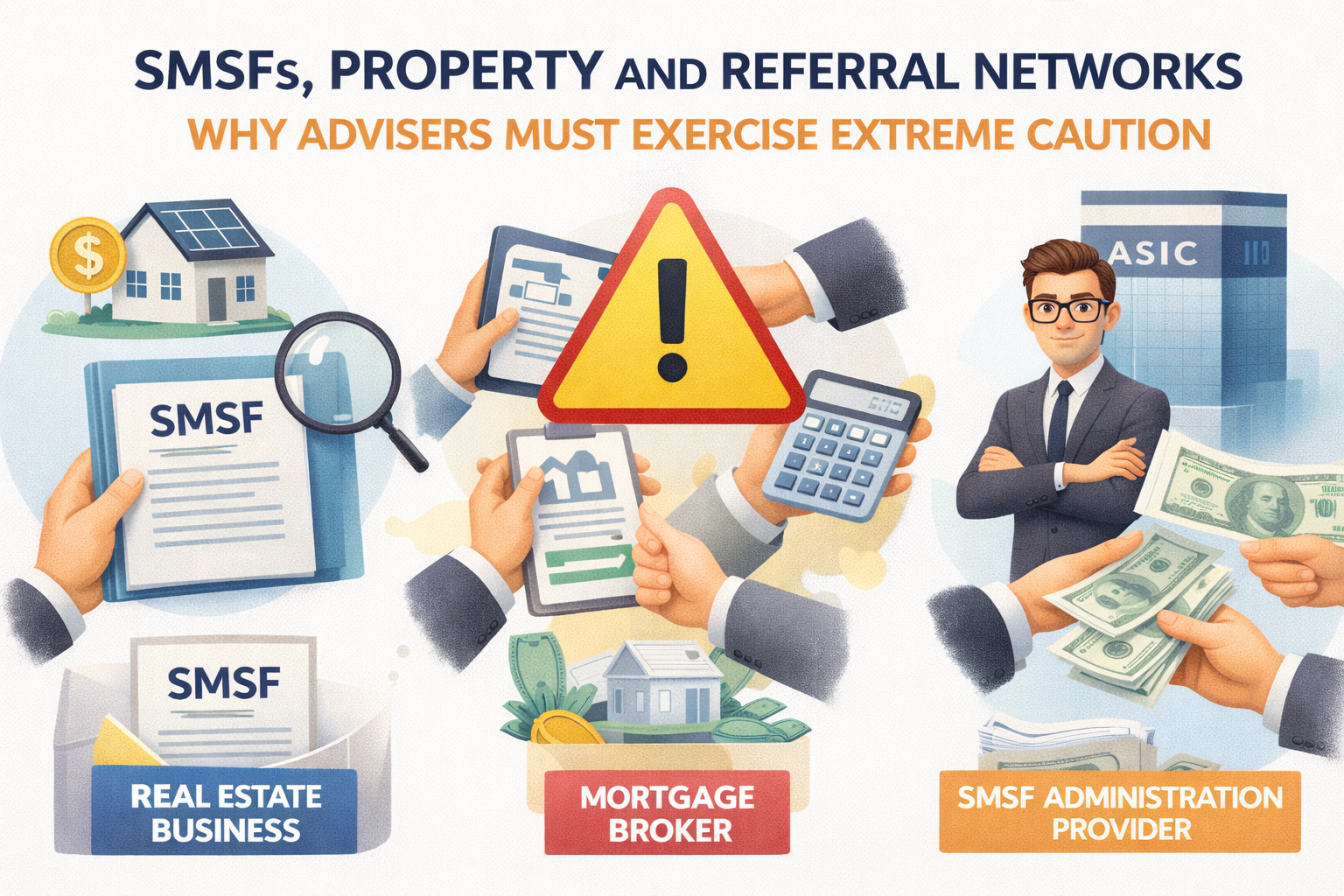
Why Advisers Must Exercise Extreme Caution
Property-based SMSF strategies—particularly those involving limited recourse borrowing arrangements (LRBAs)—remain one of the highest-risk advice areas in the financial advice profession.
ASIC’s recent regulatory work, including REP 824 – Review of SMSF establishment advice, has made it clear that many cases of client harm arise not from isolated adviser misconduct, but from multi-party referral models involving:
real estate businesses
mortgage brokers
accountants
SMSF administration providers
While each participant may only be responsible for one part of the transaction, the financial adviser remains legally responsible for the recommendation of the overall strategy.
This article explains why these arrangements are dangerous, how ASIC views them, and what advisers must consider before becoming involved in property-driven SMSF strategies.
The Typical Property-Driven SMSF Model
ASIC has repeatedly observed a common structure in non-compliant SMSF advice cases:
Real estate business identifies or markets a property opportunity
Client expresses interest in purchasing property via an SMSF
Mortgage broker arranges LRBA finance
Accountant or SMSF provider establishes the SMSF and trust structures
Financial adviser prepares the Statement of Advice recommending:
establishment of the SMSF
rollover of superannuation
borrowing within the SMSF
acquisition of property
Although the strategy involves multiple professionals, only one party provides personal financial product advice — the financial adviser.
From ASIC’s perspective, this is critical.
ASIC’s Position: The Adviser Owns the Strategy
ASIC has made it clear that where a financial adviser recommends an SMSF and LRBA property strategy:
The adviser is responsible for assessing the entire strategy — not just the components they personally arranged.
This includes responsibility for:
whether the SMSF is suitable
whether borrowing is appropriate
whether the property strategy aligns with retirement objectives
whether the risks are appropriate
whether the client is expected to be in a better position
Even if:
the property was sourced by a real estate business
the loan was arranged by a mortgage broker
the SMSF was established by an accountant
The adviser still carries the full advice risk.
ASIC Examples of Non-Compliant Advice
REP 824 includes several examples where ASIC identified significant client detriment arising from referral-driven SMSF property strategies.
Example: Off-the-plan property referrals
ASIC reviewed files where:
clients were referred by real estate businesses
clients committed to purchasing a property before receiving personal advice
advisers subsequently recommended an SMSF and LRBA to facilitate the purchase
ASIC found that in these cases:
the property decision had already been made
the adviser’s role became one of justifying the structure
risks were excessive relative to client circumstances
conflicts of interest were present
advisers prioritised commercial outcomes over client interests
ASIC concluded that this conduct failed the best interests duty and resulted in unacceptable client risk.
Why These Referral Models Are So Dangerous
1. The Adviser Becomes an Order-Taker
In many property-driven SMSF cases, the client arrives with a predetermined outcome:
“I want to buy this property in an SMSF.”
ASIC is unequivocal: SMSF/property is a solution, not a goal.
If an adviser works backwards to facilitate a property purchase, they risk:
acting as an order-taker
failing to investigate alternatives
failing to assess whether the strategy is genuinely suitable
This is a recurring enforcement theme.
2. Conflicts Are Often Structural, Not Accidental
Property referral models often involve:
referral fees (direct or indirect)
volume-based arrangements
in-house developments
associated entities
aligned commercial incentives
Even where the adviser does not receive a direct payment from the property transaction, ASIC considers whether:
the business model incentivises property recommendations
advice outcomes appear “one-size-fits-all”
similar structures are repeatedly recommended
ASIC has taken action where the advice process appears designed to produce a predetermined outcome.
3. Concentration Risk Is Commonly Extreme
Property-based SMSFs frequently result in:
a single asset representing 70–90%+ of the fund
exposure to one property
one tenant
one geographic location
one asset class
This creates significant concentration risk, which ASIC views as a major contributor to client detriment.
Advisers must consider and document:
lack of diversification
volatility risk
dependency on rental income
sensitivity to vacancies or interest rate movements
An SMSF holding one leveraged property is fundamentally different from a diversified APRA-regulated fund.
4. Liquidity Risk Is Often Overlooked
Liquidity risk is one of the most underappreciated risks in SMSF property strategies.
Property assets are:
illiquid
expensive to transact
slow to sell
difficult to partially realise
This becomes particularly problematic when clients:
approach retirement
commence account-based pensions
experience unexpected expenses
face tenant vacancies or interest rate increases
ASIC has identified numerous cases where SMSFs:
could not meet pension payment obligations
were forced to sell assets under pressure
became technically non-compliant
Advisers must assess not just whether the SMSF can service the loan today — but whether it can meet future pension cashflow requirements.
5. Pension Commencement Magnifies Risk
When pensions commence within a property-heavy SMSF:
minimum pension payments must be paid regardless of market conditions
rental income may be insufficient
loan repayments continue
asset sales may be required at unfavourable times
This combination of illiquidity + leverage + pension obligations is a high-risk environment that must be clearly explained and justified.
ASIC expects advisers to consider:
sustainability of pension payments
impact on long-term retirement income
contingency planning
stress testing
Failure to do so has featured prominently in ASIC enforcement cases.
Key Warning Signs for Advisers
SMSF strategies can materially change a client’s insurance position.
Extreme caution should be exercised where:
the client is introduced by a real estate business
the property is identified before advice is provided
the strategy is marketed as “SMSF property”
multiple parties benefit financially from the structure
the advice outcome appears predetermined
the SMSF will be largely or wholly invested in one property
These are precisely the risk indicators ASIC uses in surveillance activity.
Whether existing cover in an APRA fund should be retained
The affordability of insurance premiums inside the SMSF
How premiums will be funded over time
Whether additional insurance is required due to gearing or illiquid assets
Cancelling and reissuing insurance policies to move ownership into an SMSF is treated as product replacement and must meet all relevant policy requirements.
The Adviser’s Responsibility
Before recommending an SMSF and LRBA property strategy, advisers must be satisfied — and able to demonstrate — that:
the SMSF is suitable for the client
borrowing is appropriate
the client understands trustee responsibilities
concentration risk is acceptable
liquidity risk is manageable
pension sustainability has been assessed
insurance implications have been addressed
conflicts have been identified and neutralised
the client is expected to be in a better position
If this cannot be clearly demonstrated, the strategy should not proceed.
Final Message
Property-based SMSF strategies sit at the highest end of regulatory, legal and professional risk.
ASIC’s message through REP 824 and enforcement action is unambiguous:
SMSF advice must be client-led, not property-led
advisers must not facilitate predetermined outcomes
referral networks do not dilute responsibility
concentration and liquidity risks must be front and centre
documentation and professional judgement are critical
As an adviser, your name (and our licence) is on the Statement of Advice.
That means the risk — and the responsibility — ultimately rests with you.